Wednesday, May 9, 2007

Sceptic Gets Mired in Controversy

Well known Global Warming sceptic Professor Bob Carter gets a fair hearing and gets into trouble. He got more than flashy soundbites to elaborate on his position. He got himself against a mighty listener: Dr Stephen Schneider. All we ask that Mr Carter should also listen. To himself.

So hear Mr Carter out. In introduction, his position is that putting Carbon Dioxide (CO2) into the air is like putting coats of white paint on a house. The first quantum (layer) will reflect most of the sunshine and consecutive layers - no matter how many - will not add much more to the reflectivity. Similarly, he says, doubling CO2 is causing most of the warming and consecutive outputs are not that big of a concern.

He supports his argument by saying that warming should be seen on a very long time horizon measured in hundreds of thousands perhaps millions of years. He argues these are processes of geological length. And than he turns around and says, a shining fact to support him is the fact that in the past 3-5 years warming that is more than the background noise warming (we don't know what he means by that and he does not elaborate) has not increased.

Well done Mr Carter. No one needs to argue with you if you defeat your own argument. Twice.

First: How historic long term is 3-5 years? Probably not much.
Second: If most of the warming is caused by the doubling of CO2 and not the consequtive outputs and changes are locked in for 30-40 years already (a consensus reached by scientists of both side of the barrier) than we should worry probably even more about the destructive nature of CO2 and its effects on the whole eco - AND biosphere.

It appears that it was a noble intention on his part to broaden the definition of change - not just weather change. But Mr Carter ran into a formidable opponent in Dr Stephen Schneider. While Mr Carter is certainly an able proponent of possible changes on the geological time-scale (himself being from the Marine Geophysical Laboratory, James Cook University.)

Professor Schneider is offering advice to help scholars communicate more clearly with the media and policymakers.
Mr Schneider however is a person monitoring really broad interdisciplinary consequences. Mr Schneider being Melvin and Joan Lane Professor for Interdisciplinary Environmental Studies Department of Biological Sciences, Stanford University, he appeared to be an able advocate of very long term processes including biological ones.


To sum up ...

Allow me just two final figures to contemplate.

If animals or plants go extinct because of too high stress on their respective habitat, what goes with it is what took evolution about 25 million years of perfecting those species to that habitat. A new, drastically different habitat might take similarly long geological time spans to have a new biosphere similarly adopted.

Scientist have reached consensus and agree that ocean surface level rise is mostly due to heat expansion that is about to go on for a thousand to two thousand years.

Both are very long time spans indeed.

So what's the point of arguing consequtive CO2 emissions (that is happening today) if what is already there is so damaging for the very long term, indeed.

Congratulation to Phillip Adams of ABC Radio National LNL for convening such an informative debate and big cheers to story producer Jane Shields.

http://www.abc.net.au/rn/latenightlive/stories/2007/1913498.htm

Saturday, May 5, 2007

Cost of Global Warming Fix Uses Old Model


By the time government representatives managed to broker something they found acceptable the model it has been based on had become outdated.

Still there is something very newsworthy in this: The scientific panel was international and it included a delegation from the US. Also, price tags for Plan A, B and even C have been calculated.

Further the panel found that:

Summary report pdf to download

"... blunting the consequences of global warming will require different lifestyles, higher prices for basics including gasoline and electricity, and a much greater investment in research and development efforts."

These are very important and very striking statements. You may want to compare the statement on lifestyle change to this previous ChangeClimateBack blogpost: ../2007/04/problem-with-overconsumption.html

The other important point is that costs are affordable. However, the report is seriously lacking by it's own admission.

"... estimates of potential price increases for gas and other energy sources were not included in the report because they were based on assumptions that have not been well studied."

Now if you read between the lines, you find the the whole process of negotiation was much much longer then the 5 days delegates spent in Bangkok. As a result, the model they used was the same as it was before negotiation started. At the time relevant and inclusive, but by the time agreement was reached - outdated and old. For istance it did not include new findings that the Polar Ice cap actally melting faster than the model predicted back then.

[report] ... do not take into account the most recent discoveries -- such as findings that the Arctic ice cap appears to be melting at a much faster rate than described in the February IPCC report.
That's how much has changed just in the 4 months between February (the climate report) and May (the agreement brokered) to the model they uses as base. You can't blame them though. This was as exceptionally fast process. Today, may be enough. Tomorrow, not good enough.

Bottom Line?

It is important that now the talk is serious and is about exact costs and timelines of fixing. The complexity of the changes however is such that the model upon which calculations and predictions are based need to be updated more frequently than haggling process to reach agreement by politicians usually lasts. We may not like this but climate change is on a footing that requires emergency fast reaction time to important model changes.

... model upon which calculations and predictions are based need to be updated more frequently than usual haggling process ...

And it is even more so now, that some feedback processes start. Polar melt is a case in hand. Reduced albedo effect from white ice gone reduces reflection and increases warming as a second generation so called negative feed back process kicks in. Similarly, some trees are now reported to undergo such stress that they become net producers of CO2 - they breath carbon rather then oxigen. This is another negative feedback recently observed.

Such processes (both positive - there are a little, but could be important - and negative feedbacks) now alter model structures and acceptable predictions more rapidly. Some actual measurements now frequently and routinely carried out also defy predictions - some on the positive, some on the negative side.

Negotiations of any real merit should go real time and based on models updated in real time. In practical terms, at least adjusted in the interim before final agreements are reached.

The best medium for this would be expert internet forum, rather then a suit-and-tie air conditioned chain of events in venues across the globe. You do the sums: kerosine, gas, petrol, air-conditioning - all lost for wanting eggheads (save a respectful, but largely powerless minority) to agree on and old and outdated presumption.

Still, there is progress ...

Panel Calculates Cost of Global Warming Fix - washingtonpost.com

Friday, April 27, 2007

Simple Carbon Saving Tips - for FREE

A few simple things I am committed to do that you can do too. It costs you nothing. Nada. Zilch. (If anything you'll save.)
In fact, the state of the Planet is such that if even one of us skips trying these, it makes the effort of the rest of us so much less useful.

  • Don't use your car when you don't have to. (When I did a major research about shopping habits I found that millions of millions of people jump in the car twice daily for a singular item - loaf of bread, bottle of milk - from the local.)
  • Stop the engine when you can and it makes sense. (Most everyone I ever met on the roads, keep their engine running at long red lamps or while the boom gate is down. And it is just silly.)
  • Try not to drive alone whenever you can and it makes sense. When with friends you know are responsible drivers, give up that ego thing for a while. Jump in thier car when you "just pop out" somewhere together. The trip is always longer for some reason, but more than that. This way it'll be memorable too. You might even discover new amusing things about them.

Thursday, April 26, 2007

The problem with overconsumption

The problem with overconsumption is the overuse of global resources NOT local products. There is only so much resource the Planet can afford for a person. That amount is a zero sum (what goes in should come out) and the Planet is pretty unapologetic about that. Presently we are overeating that amount by an unhealthy margin. There is little offering solace for change.

The area needed to support one person including aquaculture, mining, agriculture and energy generation is called a per capita global hectare. It has been calculated and the figures are not pretty. Equally spread accross countries our Earth can afford 1.8 hectare per person. Presently we are using 2.2 per capita - that is 122% of all available global resources. And we cannot stretch the Planet to make it 22 percent bigger just to fit.

Now let's put that into perspective ...

If you are eating more than your body can burn - recycle it in the form of useful energy - you go fat. Then is a good idea to lose weight. But what if you that frequently. Well, the bad news is that if you can't sustain weight loss, you are going to consume EVEN MORE global resources. You will frequently spend your hard earn money for EXTRA the global resources that go into your weight loss package. It's that simple even though the calculations I imagine would be quite complex.

Similarly, if we were to go off oil globally and change to ethanol this in itself could be a poor result. Why? Because the impact on global resource consumption could actually INCREASE. Because we would need to grow immense amount of canola and other crop additionally to what we already consume just to burn it for getting from A to B. Don't get me wrong. I do think we need to use less oil. That would definitely impact LESS our global resources - no one argues that. But we would need to take that reduced usage state and convert it into someting else with similarly REDUCED loads on global resources My hunch is that if the amount of cars used keep increasing - which is likely given that the largest economies are predicted to double in the foreseeable future - then the amount of global resources consumed per capita is on the increase.

Positive growth and increase in consumption ...

Currently we measure growth with the increase of consumption. If consumption grows most economists are happy as Larry. They look at a basket of stuff we consume and they measure positive changes. By the way, in that basket cars figure prominently. And it is not likely to change any time soon.

Keep that unchanged and the planet may keep going to be overconsumed. If we just get drunk on food and fuel - and it doesn't really matter if that food or fuel is designed to trim - overconsumption is here to stay.

If your belly grows when you want to trim it you register that as a negative change. Similarly, some growth should count negative if it goes into overconsumption. So even though there would be so and so much more cars produced a portion of it should count as a negative growth, not positive.

Change your life-style - so you can GET a life ...

Now there is a good thing to be learnt from diet designers' pitch.
They all talk about the need of life-style change. Change your life so you can GET a life, the chant goes.

Actually, same should go for the Planet WITH US INCLUDED.

Change your lifestyle to GIVE life to the Planet first - and we'll all get a life BACK.

Global Climate Engine 3D Animated


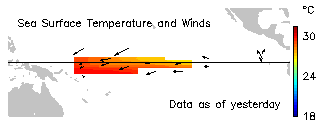
This is where the cookie crumbles. The Pacific near surface water body temperature is the Number One Global Climate Engine. This where El-Nino and La-Nina form - the climate events of planetary length and reach. They can last up to 3-5 years bringing drought or rain to areas across the Globe respectively.

Pictured is our best hope for a La-Nina - again - in nearly 60 months - that is 5 years. The cool blue shows colder surface temperature where it should be - in the Eastern Equatorial Pacific region. But previous patterns show that it needs to "bite in" for more than the half the with of the Pacific Ocean for a La-Nina to successfully stabilise.

If you switch animation to slow, you'll see that such conditions where formed a few times, none of them bringing a real La-Nina yet. Now is the chance.

Saturday, April 21, 2007

La Nina may bring RAIN and break the drought

The satellite image was computed from a multiple of buoy data (Feb. 28, 2007)

I have been following this for a few weeks now. We all know that El Nino is officially over. It is common wisdom, that La Nina (the opposite of El Nino) tends to form on the tail of its brother waning away. And now it appears that oceanic surface tempereature drop in the Equatorial Pacific (a main pattern of La Nina formation) is spreading or at least has been stabilising over the past weeks or so.
A recent update was computed (Apr. 20, 2007)
Here you can follow current data all the time.
http://www.pmel.noaa.gov/tao/

If the trend continues, welcome rain may arrive at North-Eastern Australia.
It is too early to tell though the signs are welcoming.

At the very least I am going to clean the old gutter below the eucalipt tree that I've been putting off for some time now. So when the rain comes the pipes won't be blocked. Even if it is unlikely that Victoria will receive a lot of it. But who knows, with Gods help we just might.

You folks out there don't know what RAIN will mean in Australia. We currently have the dire prospect officially announced by the PM, that the food bowl of our country (The Murray-Darling river and catchment area) will be stopped in about 5-6 weeks if welcome rain does not arrive.

So severe is the drought at the moment. Let's not contemplate what that might mean in terms of inflation and rates. Let's welcome the rain with all our heart. Let's hope that La Nina will be mighty gracious.

NOAA News Online (Story 2805)

Friday, April 20, 2007

Environmental risk awareness about Global Warming doubles in the US.

Important development in public awareness.
Environmental risk awareness about Global Warming doubles in the US.
But Americans are devided about new tax allocations to tackle the problem. Costs of tax increase on electricity and gasoline now seems to outweigh the public's growing focus on opportunity costs such as energy efficient fuel.
The situation is getting ripe for the latter as it gains bipartisan support in the House.
Efficiency is the key word in the public mind with a view to better products such as air conditioners and refrigerators.
Growing Number of Americans See Warming as Leading Threat - washingtonpost.com

New Green Entrepreneurs on the Block

Look out for them new Green Entrepreneurs with a responisble and laudable agenda. And they - Rick, Karen and Debbie have some interesting things to say. They only just started to so let's follow them with interest.
BeGreenAndSave