Thursday, April 26, 2007

Global Climate Engine 3D Animated


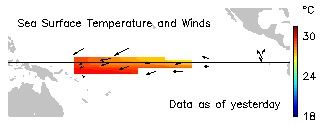
This is where the cookie crumbles. The Pacific near surface water body temperature is the Number One Global Climate Engine. This where El-Nino and La-Nina form - the climate events of planetary length and reach. They can last up to 3-5 years bringing drought or rain to areas across the Globe respectively.

Pictured is our best hope for a La-Nina - again - in nearly 60 months - that is 5 years. The cool blue shows colder surface temperature where it should be - in the Eastern Equatorial Pacific region. But previous patterns show that it needs to "bite in" for more than the half the with of the Pacific Ocean for a La-Nina to successfully stabilise.

If you switch animation to slow, you'll see that such conditions where formed a few times, none of them bringing a real La-Nina yet. Now is the chance.

Saturday, April 21, 2007

La Nina may bring RAIN and break the drought

The satellite image was computed from a multiple of buoy data (Feb. 28, 2007)

I have been following this for a few weeks now. We all know that El Nino is officially over. It is common wisdom, that La Nina (the opposite of El Nino) tends to form on the tail of its brother waning away. And now it appears that oceanic surface tempereature drop in the Equatorial Pacific (a main pattern of La Nina formation) is spreading or at least has been stabilising over the past weeks or so.
A recent update was computed (Apr. 20, 2007)
Here you can follow current data all the time.
http://www.pmel.noaa.gov/tao/

If the trend continues, welcome rain may arrive at North-Eastern Australia.
It is too early to tell though the signs are welcoming.

At the very least I am going to clean the old gutter below the eucalipt tree that I've been putting off for some time now. So when the rain comes the pipes won't be blocked. Even if it is unlikely that Victoria will receive a lot of it. But who knows, with Gods help we just might.

You folks out there don't know what RAIN will mean in Australia. We currently have the dire prospect officially announced by the PM, that the food bowl of our country (The Murray-Darling river and catchment area) will be stopped in about 5-6 weeks if welcome rain does not arrive.

So severe is the drought at the moment. Let's not contemplate what that might mean in terms of inflation and rates. Let's welcome the rain with all our heart. Let's hope that La Nina will be mighty gracious.

NOAA News Online (Story 2805)

Friday, April 20, 2007

Environmental risk awareness about Global Warming doubles in the US.

Important development in public awareness.
Environmental risk awareness about Global Warming doubles in the US.
But Americans are devided about new tax allocations to tackle the problem. Costs of tax increase on electricity and gasoline now seems to outweigh the public's growing focus on opportunity costs such as energy efficient fuel.
The situation is getting ripe for the latter as it gains bipartisan support in the House.
Efficiency is the key word in the public mind with a view to better products such as air conditioners and refrigerators.
Growing Number of Americans See Warming as Leading Threat - washingtonpost.com

New Green Entrepreneurs on the Block

Look out for them new Green Entrepreneurs with a responisble and laudable agenda. And they - Rick, Karen and Debbie have some interesting things to say. They only just started to so let's follow them with interest.
BeGreenAndSave

Sunday, March 18, 2007

How Green Altruism Can Pay

A great way to evaluate green stocks from a 50/50% safe/greedy "home base".

Link:
enviroinvestors.blogspot.com/../how-does-green-altruism-pay.html#links

Saturday, March 17, 2007

Make Markets Work for Climate

This was a major event, so I report on it in some detail. (It came ot my attention only recently.)

Make Markets Work for Climate
Amsterdam
October 16, 2006

Opening Session

Speaker:
Katherine Sierra
World Bank Vice President for Sustainable Development


The first major point was delivered right a way and it sounds like this:
On the short term fossil fuel should be part of the mix. Reason? We need to serve the "1.6 billion people in the developing world" who "have no access to modern energy sources."
Also, transformation to low carbon economy is not possible in that same term.

The "investment gap" for developing countries as a whole is about "$80 billion a year, in order to get access to energy services and generate growth."

Ms Sierra also addressed and encouraged the "good samaritan" company representative saying: "The companies and private institutions present here have realized the real meaning of Corporate Social Responsibility. They have shown leadership and courage in making viable the idea that what is good for business and communities can also be good for the climate."

This, though rhetoric and wishful in nature in nature, carries a further important message. The World Bank will expect that private companies will pick up the slack that is currently created by governments arguing issues to pretty much death.

Snapshot of the Carbon Economy today

13 governments and 62 private sector companies, a $10 billion market, 57 projects with carbon contracts, allocated World Bank funds: $1,2 billion.

"The first carbon fund – the Prototype Carbon Fund – was conceived in late 1999 several years before the Kyoto Protocol eventually entered into force. The Government of the Netherlands, along with other European governments and a cross-section of European and Japanese companies, some of them represented here today, joined hands together with the Bank as pioneers in the carbon market.

Seven years later, a market with a volume that surpassed $10 billion last year has the potential to double in 2006. The Bank manages nine carbon funds and facilities on behalf of 13 governments and 62 private sector companies. The funds have a value of about $1.9 billion. More than $1.2 billion has been allocated to 57 projects for which carbon contracts have been signed."

The profile of the market: (1) waste management; such as "solid waste land fills, waste water, and agricultural refuse." (2) small scale renewable energy; (3) forestry; (4) chemicals.

The sad realisation ...

We need large scale renewable energy in the mix NOW, because of "the long lead times associated with these projects – it takes anywhere between three to five years to obtain financing, get the necessary licenses and clearances, and complete construction before emission reductions can be generated."

2006 plus 5 years is 2011. The Kyoto protocol deadline for setting up operational large scale renewables is 2012. The window of opportunity therefore is one year.

However ...

The long term framework for low carbon market is already in the making. This could be good news, but not if it is built (as is the case now) on shifting sand. So what else we can do? We should hang on to being innovative.

There is a current whole in the Kyoto Protocol, let's plug it in. Deforestation in the tropics amounts to about 20% in greenhouse emission, yet for some reason there is no incentive in the Protocol for these countries to protect their old growth rainforests. Don't ask how that happened. The directive to plug the whole in does not cost a red cent. Yet when implemented, a whopping 20% could potentially be cut from the emission. (Being innovative offers quite an attractive cost-benefit ratio ...)

My comments

Encouraging? Depends what you make of it. It certainly is a frank assessment. The wishful forecast was that the Carbon Economy might double in the next year.

I think that would be a good trend. A doubling in volume every year for the next 5 years could create a ripple on effect to a point where that economy would automatically transform itself into a Low Carbon Economy. (I just don't think that we should discount internal mechanics of any mature robust market.) Signs of large scale renewable investments and practical interest from PPPs NGOs would then start to become more evident. That might also become the point when for governments - finally - it will become sexy to contribute 30-50% to private investment.

Matching citizens' investment dollar for dollar in Low Carbon Green Economy could effectively double starting capitals.

Meaning in simple terms, that the volume of the economy could still continue to double into the foreseeable future.

MakeMarketsWorkforClimate.pdf

Thursday, March 15, 2007

Sea level could rise faster while Antarctic gains mass

Hot off the press are some interesting findings.

In brief:
If iceberg calving in the Antartic (huge chunks braking off the ice shelves) continue at current rate, glaciers could get involved. It appears that, if unencumbered, they slip faster into sea, then previously thought. This could far accelerate sea level rise beyond the currently projected 28-43 cm over the next 100 years.
However, overall, the Antarctic is not likely to loose ice mass. Instead it will gain from more intense precipitation in the form of snow fall. Also, widespread thawing of the Antarctic is not likely due to the extreme cold.
This current finding seems to support the idea that the Atlantic sea mass and currents are at greater risk of widespred change then the Pacific. For that reason too, when it comes to regulating oceanic changes, Earth agmentation should start at the Gulf. Check out this article on the subject.

http://www.sustdev.org/index.php?option=content&task=view&id=1708

Saturday, March 10, 2007

Artificial Photosynthesis - to power up and mop-up

Fields of iron plants to power up and mop up.

Inspirational, doable and viable. And they are only years away thanks to a new breakthrough that pinpointed the heart of the real photosynthesis: a single atom of manganese.

Artificial systems will mimic the water-splitting chemistry of natural photosynthesis, they will not look like plants. Artificial systems will use metals such as ruthenium and iron.

Future Hi: Promise of Artificial Photosynthesis